DXY Explained: The US Dollar Index for Forex Traders
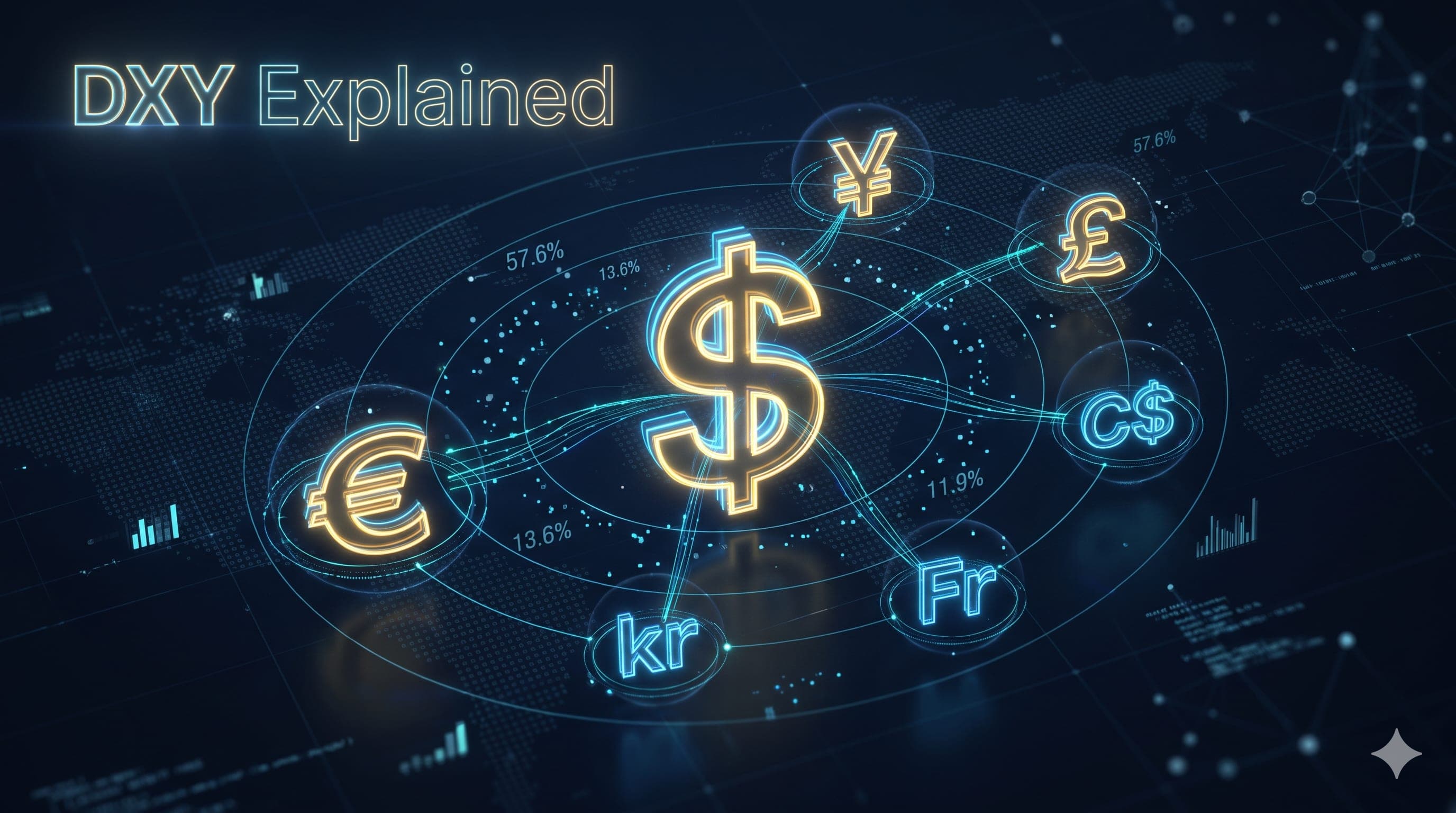
Quick answer: The DXY, or US Dollar Index, measures the dollar's value against a basket of six major currencies, led by the euro. When DXY rises, the dollar is broadly strengthening, which often means EURUSD and gold are under pressure. Traders use it as context for their setups, not as a trade signal on its own.
Key takeaways
DXY tracks the dollar against EUR, JPY, GBP, CAD, SEK and CHF.
The euro makes up more than half the index, so DXY and EURUSD usually move in opposite directions.
Gold often, but not always, moves opposite to the dollar.
Use DXY to check whether a move is about the dollar or about the other currency.
Correlations shift over time, so DXY is a guide, not a rule.
If you trade any pair with USD in it, or gold, the dollar's broad direction affects you. The DXY is the quickest way to see that direction. Here is how it works and how traders use it.
What is the DXY?
The DXY is an index that compares the US dollar with a weighted basket of six currencies.
It started at a base value of 100 in March 1973. A reading above 100 means the dollar is stronger against the basket than it was then; below 100 means weaker. Day to day, traders care less about the level and more about the direction.
Which currencies are in the DXY?
Six currencies, with the euro carrying by far the most weight. The approximate weights are:
Euro (EUR): about 57.6%
Japanese yen (JPY): about 13.6%
British pound (GBP): about 11.9%
Canadian dollar (CAD): about 9.1%
Swedish krona (SEK): about 4.2%
Swiss franc (CHF): about 3.6%
Because of the euro's weight, DXY behaves a lot like an inverted EURUSD chart. It does not include emerging-market currencies such as the Indian rupee or Chinese yuan.
How does DXY relate to forex pairs?
When DXY rises, pairs with USD as the quote currency tend to fall, and pairs with USD as the base tend to rise.
EURUSD and GBPUSD usually fall when DXY rises.
USDJPY and USDCAD usually rise when DXY rises.
This is a tendency, not a certainty. A pound-specific event can move GBPUSD regardless of the dollar. For a broader look, see forex currency pairs explained.
How does DXY relate to gold?
Gold is priced in dollars, so a stronger dollar often weighs on gold and a weaker dollar often supports it.
But the link breaks down regularly. In periods of global stress, both the dollar and gold can rise together as investors look for safety. Interest-rate expectations and central-bank demand also drive gold independently. Treat the inverse relationship as context. Our guide on how traders approach XAUUSD covers the other drivers.
How do traders use DXY in practice?
Mostly as a filter and a confirmation check, not as an entry trigger.
Check the dollar's trend on the same timeframe as your trade before entering a USD pair or gold.
Ask whose move it is. If EURUSD falls while DXY is flat, the euro may be weak rather than the dollar strong.
Avoid doubling up. Selling EURUSD and GBPUSD and buying USDJPY together is close to one large dollar bet.
Watch DXY at key levels before big US data like NFP or CPI. See what is NFP.
Combine it with your own analysis of support, resistance and structure on the pair you trade.
Many community trade ideas on gold and USD pairs reference dollar strength in their reasoning. See examples on the free FXfolder Telegram channel.
What are the limits of the DXY?
It is heavily weighted to the euro, excludes many major trading partners, and its correlations change over time.
That means it can miss dollar moves against currencies outside the basket, and it can tell you little about pairs that do not involve the dollar. It describes the dollar; it does not predict it.
Frequently asked questions
What does DXY stand for?
It is the ticker commonly used for the US Dollar Index, which measures the dollar against six major currencies.
Does a rising DXY mean gold will fall?
Often, but not always. Gold and the dollar can rise together during market stress, and other factors like interest-rate expectations also matter.
Can I trade the DXY directly?
The index is traded through futures and some CFD products, depending on your broker and location. Many forex traders simply use it as a reference chart.
Why is DXY so similar to EURUSD?
Because the euro makes up more than half of the index. A big move in EURUSD almost always shows up as an opposite move in DXY.
Does the DXY include the Indian rupee?
No. It only includes the euro, yen, pound, Canadian dollar, Swedish krona and Swiss franc.
See how vetted traders read the dollar and gold, with every trade idea tracked. Try FXfolder free for 7 days on the plans page.
Risk disclaimer: Forex and gold trading involves substantial risk of loss and is not suitable for every investor. Correlations between markets change and are not guaranteed. All content on FXfolder is for educational purposes only and does not constitute financial, investment, or trading advice. Past performance is not indicative of future results.
Educational content only. Not investment advice.