Entry,Stop-Loss & Take-Profit Explained for New Traders
Trader
Three numbers decide the fate of every forex trade you'll ever place. Not the pair, not the strategy, not the "gut feeling" three prices you set before you enter. Get comfortable with them and most of trading stops feeling like guesswork.
In one line: The entry is where you open the trade, the stop-loss is where you exit if you're wrong, and the take-profit is where you exit if you're right. Together they define your risk, your reward, and your entire plan before a single thing can go wrong.
Key takeaways
Entry = where you open the position.
Stop-loss (SL) = your exit if you're wrong. This is the one that protects your account.
Take-profit (TP) = your exit if you're right.
Entry-to-SL is your risk; entry-to-TP is your reward.
A healthy risk-reward ratio (say, 1:2) means your target is bigger than your risk.
Every FXfolder trade idea carries all three, tracked publicly on the performance page.
What is an entry price?
The entry is simply the exchange rate where you open the trade. Buy (go long) if you expect the price to rise; sell (go short) if you expect it to fall.
Some traders enter instantly at market price. Others set a pending order to trigger only when price reaches a specific level. Either way, a proper trade idea always states the entry you should never be left guessing where the plan begins.
What is a stop loss, and why does it matter more than anything else?
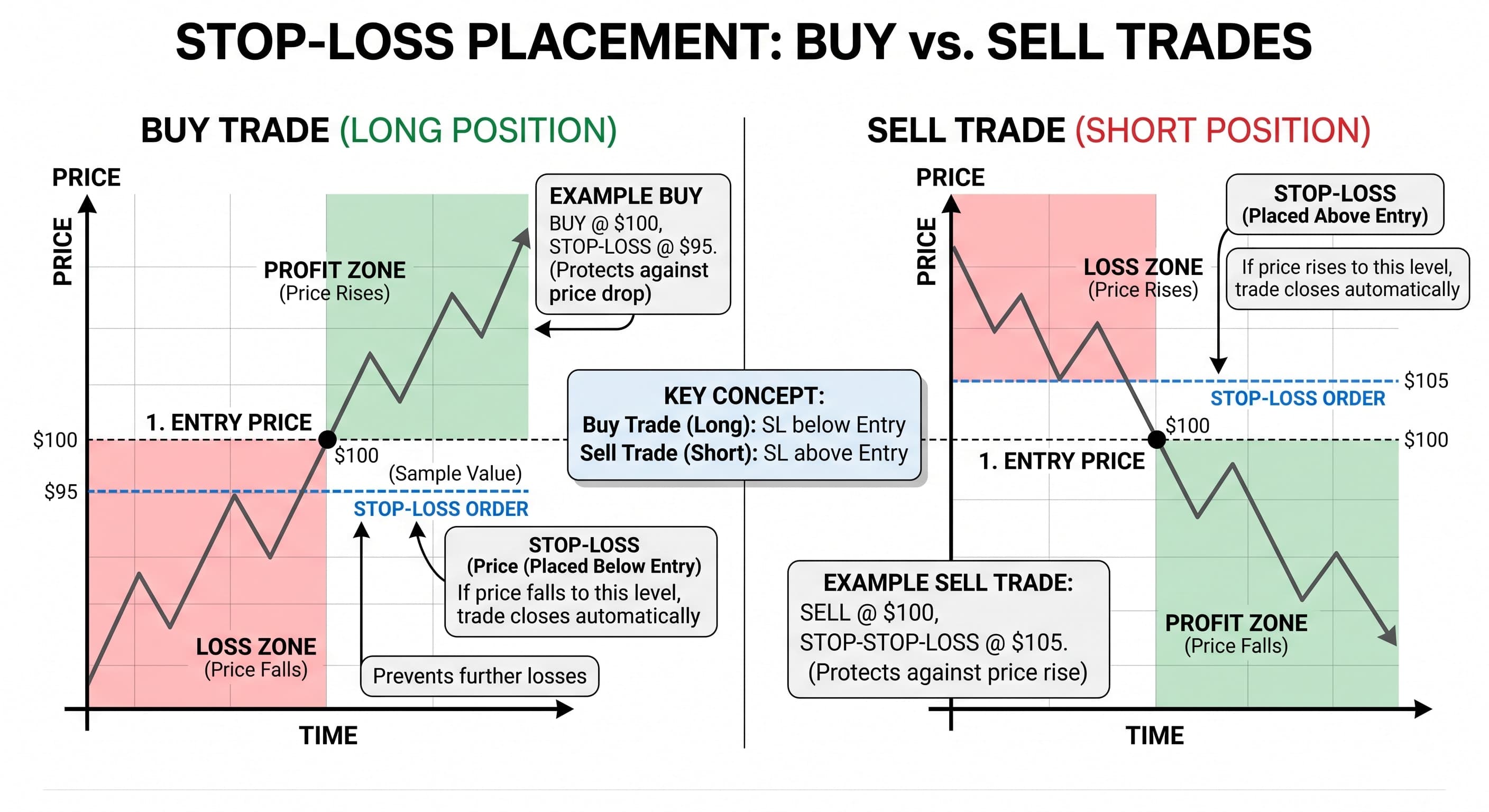
A stop-loss is a price you set in advance where the trade closes automatically at a loss. Think of it as a seatbelt: you hope you never need it, and you never drive without it.
On a buy, it sits below your entry. On a sell, it sits above. The direction changes; the job doesn't it answers the only question that keeps you in the game: if I'm wrong, how much do I lose?
Here's the blunt truth after watching countless beginners: skipping the stop-loss is the fastest way to blow up an account. One trade that "just needs a little more room" becomes the trade that takes everything. Set it, respect it, and move on.
What is a take-profit?
A take profit is the mirror image a pre set price where the trade closes automatically in profit. On a buy it sits above entry; on a sell, below.
Its real value is removing emotion from the exit. Without one, you'll watch a winning trade, get greedy, hold too long, and give it all back. Decide your target in advance and let the trade do its job while you do something else.
How do the three work together?
One line ties the whole trade together. Here's an illustrative example — example prices only, not a live idea:
Buy EUR/USD — Entry 1.0800, Stop-loss 1.0770 (risk = 30 pips), Take-profit 1.0860 (reward = 60 pips).
If price falls to 1.0770 you lose 30 pips and you're out. If it climbs to 1.0860 you gain 60 pips and you're out. Your reward is double your risk a 1:2 risk-reward ratio. That structure is the backbone of every trade idea, and reading it fluently is the next skill worth building: see how to read a forex trade setup.
Why risk-reward matters more than win rate
The risk-reward ratio compares what you're risking to what you're aiming to gain. Risk 1 to make 1 is 1:1; risk 1 to make 2 is 1:2 (a common target); risk 1 to make 3 is 1:3 (ambitious).
Here's the part beginners miss. With a solid ratio, you can be wrong more often than you're right and still finish ahead, because your wins are simply bigger than your losses. That's why experienced traders obsess over risk-reward instead of chasing a high win percentage — and it's why FXfolder ranks traders by a confidence-adjusted win rate rather than raw wins alone. A 90% win rate means nothing if the 10% wipes out the 90%.
How should a beginner set SL and TP?
A few principles (educational, not advice) and if you want these taught properly, the FXfolder Academy walks through risk management in depth:
Set your stop-loss from the chart, not your wallet place it where the idea would genuinely be wrong (beyond a recent swing high or low), then size the position so that distance costs only a small, comfortable slice of your account. Cap risk at a fixed percentage per trade; many traders use 1–2%. Aim for a reward bigger than your risk wherever the setup allows. And never — this one's non-negotiable — drag your stop-loss further away once you're losing. That single habit turns small, survivable losses into account-enders.
A note for traders in India
Watch the IST timing of the London and New York sessions (roughly early afternoon to late night) — that's when volatility, and opportunity, peaks. And be aware that trading offshore forex/CFD platforms sits under RBI/FEMA considerations, with SEBI-awareness advised. Know your local position before you trade.
Frequently asked questions
What do entry, stop-loss and take-profit mean in forex?
Entry is where you open a trade, stop-loss is where it closes automatically if the trade moves against you, and take-profit is where it closes in profit. Together they set your risk and reward before you enter.
Where should I place my stop-loss?
Place it where your trade idea would clearly be invalid — often just beyond a recent swing high or low — not at a random distance. Then size your position so that stop distance represents only a small percentage of your account.
What is a good risk-reward ratio for beginners?
Many beginners target at least 1:2, so the take-profit is twice as far from entry as the stop-loss. This keeps you profitable over time even if you win fewer than half your trades, though no ratio guarantees results.
Do FXfolder trade ideas include stop-loss and take-profit?
Yes. Every idea has a defined entry, stop-loss, and take-profit, and each outcome is tracked publicly on the performance page losses included.
Can I still lose money with a stop-loss set?
Yes. A stop-loss caps how much you lose on a trade, but losses are still possible, and in fast markets a stop can fill slightly worse than expected. Forex always carries a substantial risk of loss.
Want to see entry, SL and TP on real, tracked setups?
Follow the free FXfolder Telegram channel to watch ideas play out, or start a 7-day free trial on the plans page.
Educational content only. Not investment advice.