Moving Averages in Forex: How to Use Them (Without the Hype)
Trader
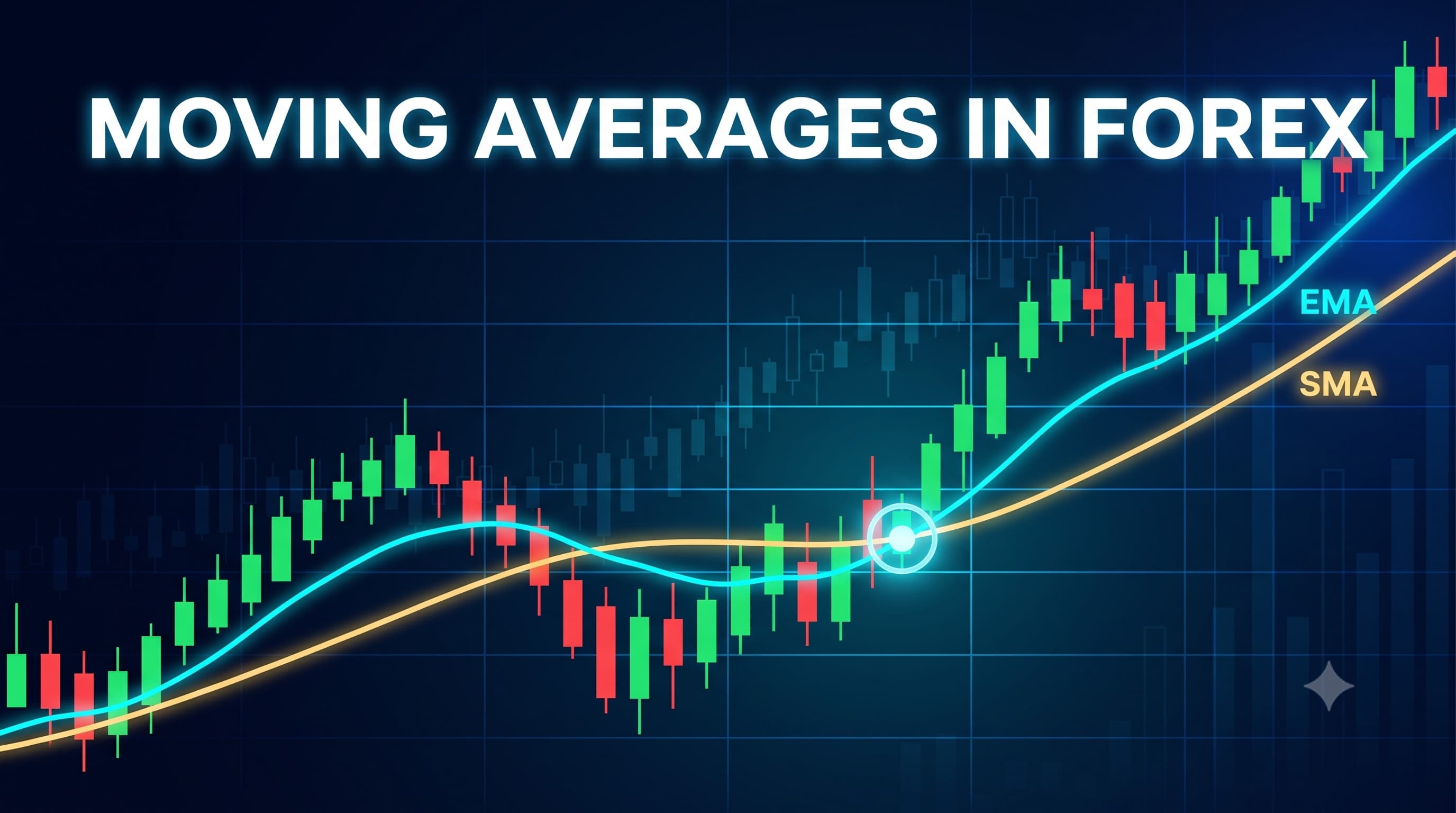
Quick answer: What is a moving average in forex?
A moving average smooths out price by averaging it over a set number of periods, making the underlying trend easier to see. Traders use moving averages to gauge trend direction, spot potential support and resistance, and watch for crossovers. They’re a helpful trend tool but they lag price and don’t predict the future.
Key takeaways
A moving average smooths price to reveal the trend.
SMA weights all periods equally; EMA reacts faster to recent price.
Crossovers are watched as possible trend-change signals.
Moving averages lag they confirm trends, they don’t forecast them.
How does a moving average work?
It plots the average price over a chosen number of periods, updating as new prices form. A 50-period moving average, for instance, shows the average of the last 50 candles. As price moves, the line moves with it, smoothing out the noise so the broader direction is clearer.
The result is a single, flowing line that’s far easier to read than raw, jagged price which is exactly why it’s one of the most popular indicators in trading.
SMA vs EMA: what’s the difference?
A Simple Moving Average (SMA) weights every period equally; an Exponential Moving Average (EMA) gives more weight to recent prices. Because the EMA reacts faster to new price action, it’s favoured by shorter-term traders who want quicker signals. The SMA is smoother and slower, which some traders prefer for filtering out noise. Neither is “better” they’re just tuned differently.
How do traders use moving averages?
Mainly for trend direction, dynamic support/resistance, and crossovers. Common uses include:
Trend direction — price above a rising average suggests an uptrend; below a falling one suggests a downtrend.
Dynamic support and resistance — price often reacts around a well-watched average like the 50 or 200.
Crossovers — when a faster average crosses a slower one, some traders read it as a possible trend shift.
What is a moving average crossover?
A crossover happens when a shorter average crosses above or below a longer one. A shorter average crossing above a longer one (sometimes called a “golden cross” on major averages) is read as potentially bullish; the reverse (a “death cross”) as potentially bearish. These are watched widely but they lag, and they can produce false signals in choppy markets, so confirmation and a stop-loss matter.
The limitations of moving averages
Moving averages lag price they follow it, they don’t lead it. By the time an average confirms a trend, part of the move may already be over. In sideways, choppy markets they can whipsaw, giving repeated false signals. That’s why experienced traders treat them as one tool among several often combined with support and resistance or price action rather than a standalone system.
How FXfolder helps you learn indicators
FXfolder is an educational community platform, not a signal seller, and using indicators sensibly is part of the education:
Educational analysis showing how tools like moving averages fit into a wider read.
Transparent trade history so you can study real setups.
A free Telegram community to learn alongside other traders.
Frequently asked questions
What is the best moving average for forex?
There’s no single best one. The 50 and 200 are widely watched for longer trends, while shorter averages suit faster trading. The “best” depends on your timeframe and strategy.
Should I use SMA or EMA?
EMAs react faster to recent price, which suits shorter-term traders; SMAs are smoother and slower. Many traders test both and choose based on their style and timeframe.
Are moving average crossovers reliable?
They’re popular but lagging, and they can give false signals in choppy markets. They work best as one input alongside other analysis, with a stop-loss to manage failed signals.
Can I trade using only moving averages?
It’s not advisable. Because they lag and whipsaw in ranges, they’re best combined with support and resistance, price action, and solid risk management.
The bottom line
Moving averages smooth price to reveal the trend, and traders use them for direction, dynamic levels, and crossovers. But they lag price and can whipsaw in choppy markets, so treat them as one tool among several never a crystal ball. Combined with other analysis and risk control, they’re genuinely useful.
Learn indicators with a community: Join FXfolder’s free Telegram channel for educational, transparent trade ideas.
Risk disclaimer: Forex trading involves substantial risk of loss and is not suitable for every investor. All content on FXfolder is for educational purposes only and does not constitute financial, investment, or trading advice. Past performance is not indicative of future results. Always do your own research and consider your risk tolerance before trading.
Educational content only. Not investment advice.