Smart Money Concepts for Beginners: OBs and FVGs
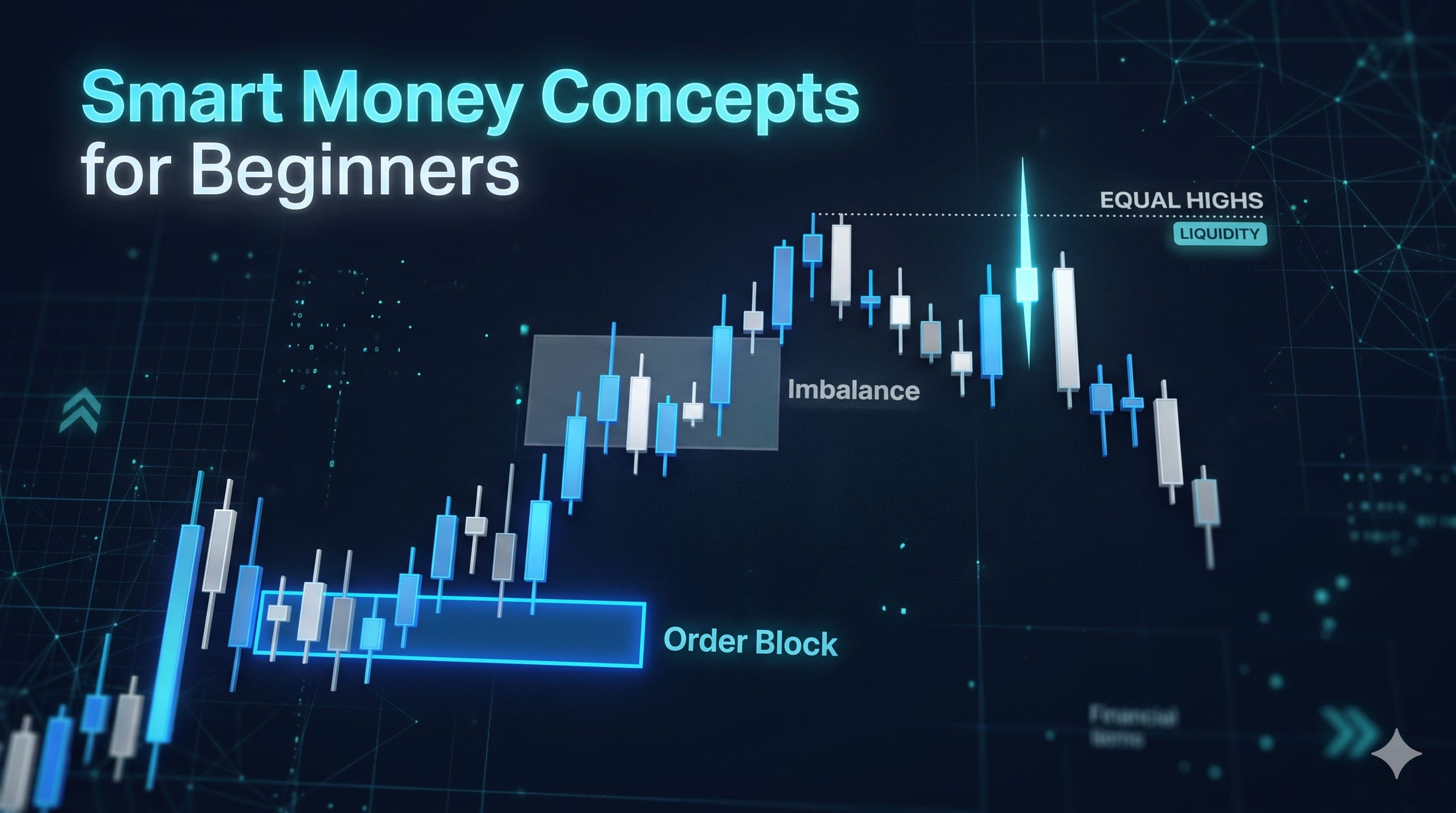
Quick answer: Smart money concepts (SMC) are a way of reading charts that assumes large institutions leave footprints in price. The main tools are market structure, order blocks, fair value gaps and liquidity sweeps. SMC can give clear, rule-based entries and stops, but it is an interpretation of price, not a proven edge.
Key takeaways
Start with market structure: higher highs and lows, or lower highs and lows.
An order block is the last opposing candle before a strong move.
A fair value gap is a three-candle imbalance where price moved too fast to fill.
Liquidity sweeps are quick moves through obvious highs or lows that then reverse.
SMC still needs a stop loss, sensible size and a tracked record to judge it.
Many trade ideas shared by community traders mention SMC terms like BOS, order block or FVG. If those words sound like jargon, this guide explains smart money concepts in plain English, with the limits stated honestly.
What are smart money concepts?
SMC is a chart-reading approach built on the idea that big players, such as banks and funds, move price in ways that leave visible patterns.
Supporters argue that following those patterns helps retail traders trade with large orders rather than against them. Critics point out that many SMC ideas are renamed versions of older concepts like supply and demand and support and resistance. Both views can be true: the labels are new, the price behaviour is not.
What is market structure in SMC?
Market structure is the pattern of swing highs and lows that tells you whether price is trending up, down or ranging.
Bullish structure: higher highs and higher lows.
Bearish structure: lower highs and lower lows.
Break of structure (BOS): price breaks a previous swing in the trend's direction, suggesting continuation.
Change of character (CHoCH): price breaks a swing against the trend, an early sign it may be turning.
Our community guide on how to read market structure goes deeper with chart examples.
What is an order block?
An order block is the last opposite-coloured candle (or small group of candles) before a strong move that breaks structure.
For a bullish order block, it is the last down candle before a sharp rally. SMC traders mark that candle's range as a zone where price may react if it returns, on the theory that unfilled institutional orders sit there.
Not every last candle is meaningful. Traders usually look for order blocks that led to a clear break of structure and have not yet been revisited.
What is a fair value gap (FVG)?
A fair value gap is a three-candle pattern where the wicks of the first and third candles do not overlap, leaving a gap in price.
It shows price moved so quickly in one direction that little trading took place in that range. SMC traders expect price to come back and "fill" part of the gap before continuing. FVGs often sit next to or inside order blocks, and traders combine the two for entries.
What is a liquidity sweep?
A liquidity sweep is a quick move through an obvious high or low, where many stop losses sit, followed by a reversal.
Equal highs, equal lows and recent swing points attract stops. A sharp move that takes those out and then reverses is read as large players collecting liquidity before moving the other way. It is one reason SMC traders avoid placing stops at the most obvious levels.
How do SMC traders build a trade idea?
Usually by combining higher-timeframe structure, a liquidity sweep, a lower-timeframe structure shift, and an entry at an order block or FVG.
Identify the trend on a higher timeframe.
Wait for price to sweep liquidity into a key zone.
Look for a change of character on a lower timeframe.
Enter on a return to the new order block or fair value gap.
Place the stop beyond the swing that created the setup, and target opposing liquidity.
You can see this logic applied in real breakdowns from community traders, such as this XAU/USD buy trade breakdown.
What are the limits of smart money concepts?
SMC is subjective, easy to apply in hindsight, and has no guaranteed edge.
Two traders can mark different order blocks on the same chart.
Patterns look obvious after the fact and much less clear in real time.
Lower timeframes produce many false signals.
The "institutions" story is a model, not something you can verify on a retail chart.
The fix is the same as for any method: define your rules, test them on a demo account, size every trade from the stop, and judge the approach by a tracked record, losses included. See support and resistance in forex for the older concepts SMC builds on.
See SMC-based setups with entry, stop and targets stated up front on the free FXfolder Telegram channel.
Frequently asked questions
Is smart money concepts trading profitable?
Some traders do well with it and many do not. SMC is a framework, not a guarantee. Judge it by a tracked record of your own or another trader's results over many trades.
Is SMC good for beginners?
It can be, because it gives clear entry and stop rules. But beginners should first understand basic structure, support and resistance, and risk management, or the jargon becomes a distraction.
What is the difference between an order block and supply and demand?
They overlap heavily. An order block is a specific candle-based definition of a zone; supply and demand zones are usually drawn more broadly. Many traders see SMC as a refinement of supply and demand.
What timeframe is best for smart money concepts?
Many traders use a higher timeframe, like 4-hour or daily, for direction and a lower one, like 15-minute, for entries. Very low timeframes produce more noise.
Do FXfolder traders use SMC?
Some community traders do, and their trade ideas explain the reasoning, such as structure breaks or supply zones. Every idea's outcome is tracked, so you can judge the method by results, not labels.
Learn SMC from real, tracked trade ideas instead of hindsight charts. Try the FXfolder community free for 7 days on the plans page.
Risk disclaimer: Forex and gold trading involves substantial risk of loss and is not suitable for every investor. All content on FXfolder is for educational purposes only and does not constitute financial, investment, or trading advice. Trade ideas shared in the FXfolder community are posted by independent traders. Past performance is not indicative of future results.
Educational content only. Not investment advice.