Technical vs Fundamental Analysis in Forex: What’s the Difference?
Trader
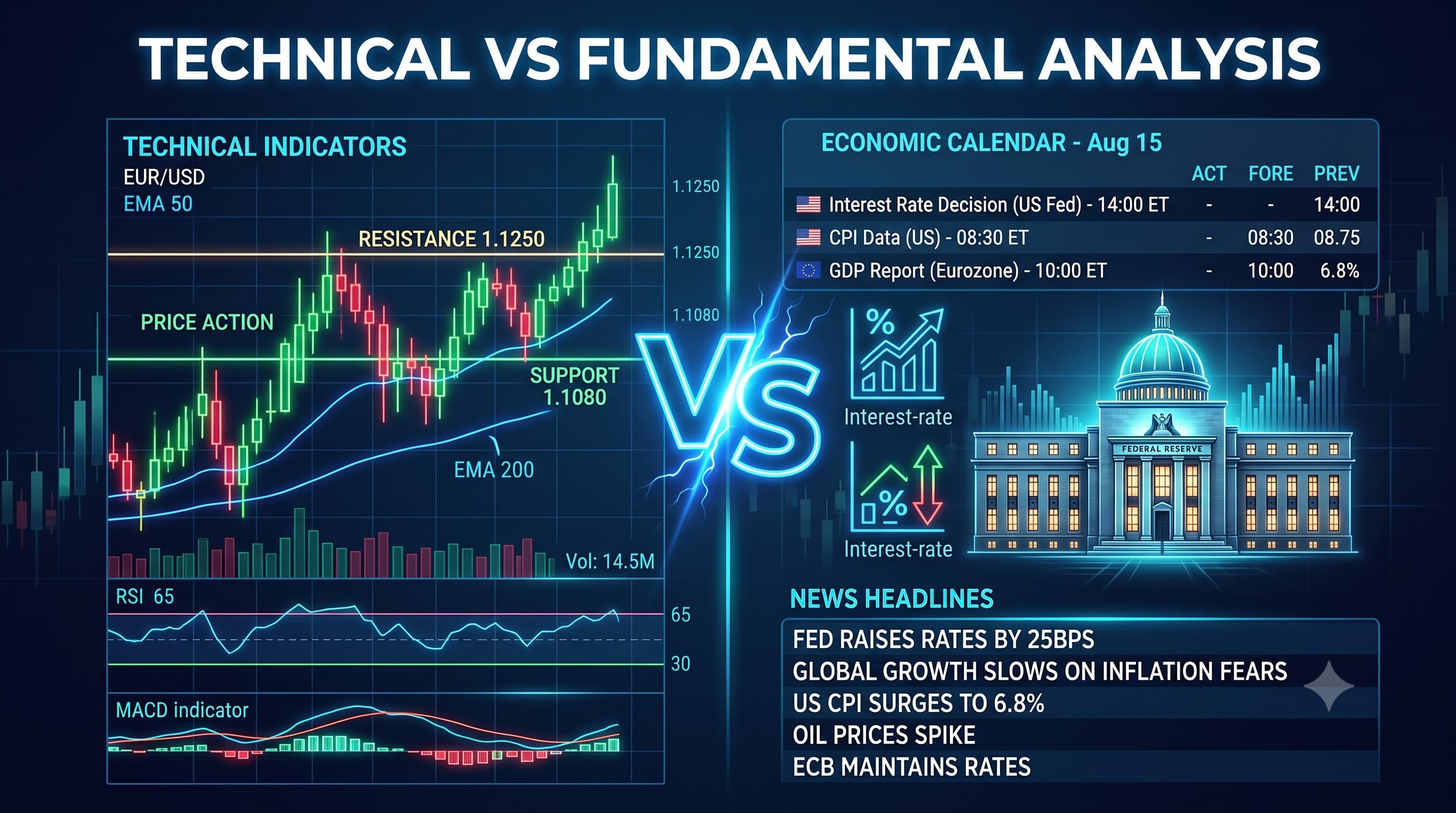
Quick answer: What is the difference between technical and fundamental analysis?
Technical analysis studies price charts and patterns to forecast movement; fundamental analysis studies economic data and events to judge a currency’s value. Technicals ask “what is price doing?” while fundamentals ask “why?” Neither is guaranteed to be right, and many traders combine both for a fuller picture.
Key takeaways
Technical analysis = charts, patterns, and price action.
Fundamental analysis = economics, interest rates, and news.
Technicals focus on timing; fundamentals focus on direction and value.
Many traders blend both rather than choosing one.
What is technical analysis?
Technical analysis is the study of price charts to identify patterns and probabilities. Technical traders assume that price reflects everything known about the market, so they focus on things like support and resistance, trends, candlestick patterns, and indicators rather than the news behind the moves.
Its strength is timing: it helps you decide when to enter and exit, and where to place stops and targets.
What is fundamental analysis?
Fundamental analysis is the study of economic and political factors that drive currency value. Fundamental traders look at interest rates, inflation, employment data, central bank policy, and geopolitical events to judge whether a currency should strengthen or weaken.
Its strength is context: it explains why a currency is moving and where it might head over the bigger picture. Following the economic calendar is central to this approach.
How do the two approaches differ?
They answer different questions. Technical analysis is about what price is doing and when to act — it’s chart-focused, works across all timeframes, and suits shorter-term trading. Fundamental analysis is about why a currency has value and where it’s heading it’s data focused, tends to play out over longer periods, and suits a bigger picture view.
A technical trader might see a breakout and act on it; a fundamental trader might hold a longer position because a central bank is raising rates. Both can be right they’re just looking through different lenses.
Which is better for forex trading?
Neither is universally “better” they serve different purposes. Short-term traders often lean technical because timing is everything on small timeframes. Longer-term traders often weight fundamentals more heavily. The truth is that price and economics are connected: fundamentals often explain the big moves that technicals then map on the chart.
Why many traders combine both
Combining the two gives you direction and timing together. A common approach is to use fundamentals to decide what and which way to trade, then use technicals to decide when to enter and where to place risk. For example, a trader bullish on a currency for fundamental reasons might wait for a technical pullback to a support level before buying. Used together, they cover each other’s blind spots.
How FXfolder supports both approaches
FXfolder is an educational community platform, not a signal seller, and its analysis draws on both lenses:
Educational analysis that explains both the chart and the context behind ideas.
Transparent trade history so you can see how reasoning played out.
A free Telegram community to learn alongside other traders.
Frequently asked questions
Is technical or fundamental analysis better for beginners?
Many beginners start with technical analysis because charts give clear, visual entry and exit rules. But understanding basic fundamentals like why news moves markets helps avoid nasty surprises.
Can I use both technical and fundamental analysis?
Yes, and many traders do. A common method is using fundamentals for direction and technicals for timing, so the two approaches complement each other.
Does technical analysis actually work?
It can improve your read on probability and timing, but it doesn’t predict the future. Like any method, it needs confirmation and risk management, and it won’t guarantee profit.
What is the main tool of fundamental analysis?
The economic calendar is central, along with central-bank decisions and key data like interest rates, inflation, and employment. These shape a currency’s longer term value.
The bottom line
Technical analysis tells you what price is doing and when to act; fundamental analysis tells you why and where a currency may head. Neither guarantees results, but together they give direction and timing. Learn both lenses, and you’ll understand the market far better than relying on either alone.
Learn both with a community: Join FXfolder’s free Telegram channel for educational, transparent trade ideas.
Risk disclaimer: Forex trading involves substantial risk of loss and is not suitable for every investor. All content on FXfolder is for educational purposes only and does not constitute financial, investment, or trading advice. Past performance is not indicative of future results. Always do your own research and consider your risk tolerance before trading.
Educational content only. Not investment advice.