What Is a Prop Firm? How Funded Trading Accounts Work in 2026

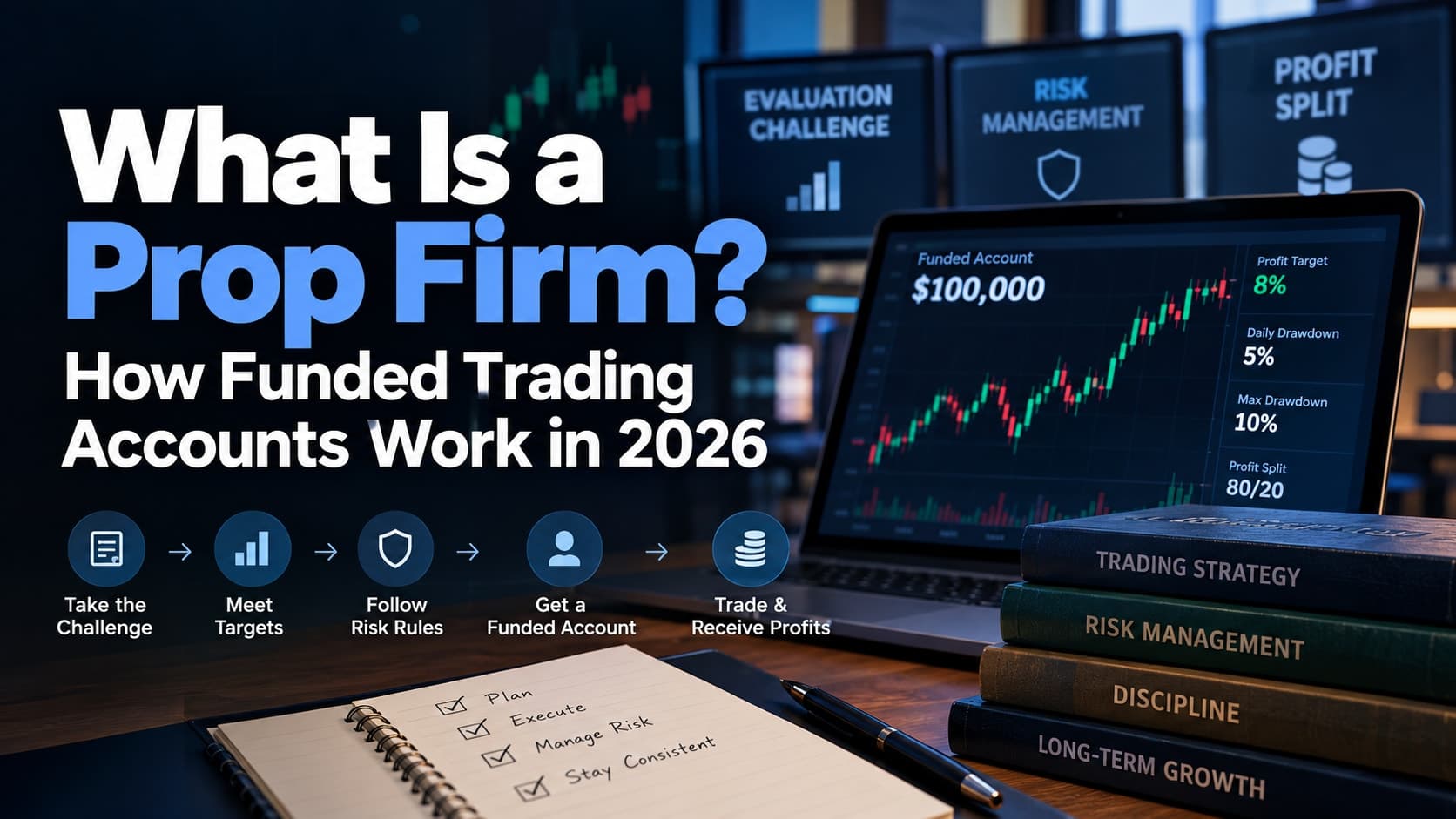
If you have spent any time in the trading community, you have probably come across terms like prop firm, funded trading account, prop firm challenge, or funded trader.
These programs have become a popular way for traders to access trading programs with larger account sizes without depositing a large amount of personal trading capital.
But how do prop firms actually work? What is a funded trading account? What is a prop firm challenge? And what do terms such as profit target, daily drawdown, maximum drawdown, and profit split actually mean?
This guide explains the prop-firm model from the ground up.
Important: Prop-firm rules, fees, account structures, payout conditions, and permitted trading strategies vary between providers and can change over time. Always read the current terms of a specific provider before purchasing or joining a program.
What Is a Prop Firm?
A proprietary trading firm, commonly called a prop firm, is a company that trades financial markets using capital allocated by the firm.
Traditional proprietary trading firms typically employ or contract professional traders and provide them with access to the firm's trading infrastructure and capital.
However, the term prop firm is also commonly used today for companies offering retail trader funding programs.
These programs generally allow traders to demonstrate their trading ability under a defined set of risk-management rules. Depending on the provider and program, a trader who meets the requirements may become eligible for a funded or simulated funded account and potentially receive a share of trading profits.
The important point is that not every modern "funded account" operates in the same way.
Some programs use simulated trading environments, while others may involve actual market execution or capital allocation. The exact structure depends on the provider.
What Is a Funded Trading Account?
A funded trading account is an account provided through a prop-firm program that gives a trader access to a specified trading environment and account size subject to the firm's rules.
For example, a provider might advertise a program with a:
$10,000 account
$50,000 account
$100,000 account
$200,000 account
The account size does not necessarily mean that the trader has $100,000 of cash available to withdraw or freely lose.
Instead, the trader usually operates within a defined risk framework.
For example, imagine a hypothetical $100,000 program with:
8% profit target
5% maximum drawdown
3% daily drawdown
The trader isn't simply being given $100,000 to spend.
The account is governed by specific conditions. Breaking those conditions may result in the account being terminated or the trader becoming ineligible for the next stage.
This is why understanding the risk rules is often more important than simply looking at the advertised account size.
How Does a Prop Firm Work?
Although programs differ, a typical retail prop-firm process looks something like this:
Step 1: Choose a trading program
↓
Step 2: Pay the applicable fee or enter the program
↓
Step 3: Trade according to the evaluation rules
↓
Step 4: Reach the required performance criteria without violating the risk rules
↓
Step 5: Complete any additional verification or evaluation stage
↓
Step 6: Receive access to the next stage or funded program
↓
Step 7: Trade according to the provider's rules
↓
Step 8: If eligible, request or receive a share of profits according to the program's terms
This process varies considerably between companies.
Some providers have a single evaluation stage, while others use multiple stages. Some offer programs without traditional challenges, while others use different structures entirely.
What Is a Prop Firm Challenge?
A prop firm challenge is an evaluation program designed to assess whether a trader can meet specified performance and risk-management requirements.
A typical challenge may include requirements such as:
Achieving a specific profit target
Staying below a maximum drawdown
Staying below a daily loss limit
Trading for a minimum number of days
Following position-size restrictions
Following rules regarding news events
Following overnight or weekend trading restrictions
Avoiding prohibited trading strategies
The exact requirements depend on the provider.
For example, a hypothetical challenge might look like this:
RuleExampleAccount size$100,000Profit target8%Maximum drawdown10%Daily drawdown5%Minimum trading days5
These numbers are only an example and should not be interpreted as the rules of a particular prop firm.
What Is a Profit Target?
A profit target is the amount of profit a trader must generate during an evaluation period to satisfy one of the program's requirements.
Suppose a hypothetical program has:
Account size: $100,000
Profit target: 8%
The trader would need to generate:
$100,000 × 8% = $8,000
So the account would need to reach the relevant target level according to the provider's calculation methodology.
However, reaching the profit target alone may not be enough.
The trader may also need to:
Avoid the daily drawdown limit
Avoid the maximum drawdown
Meet minimum trading-day requirements
Follow restrictions on trading strategies
This is why a trader can make a significant amount of profit and still fail an evaluation if the account violates one of the risk rules.
What Is Drawdown?
Drawdown is one of the most important concepts to understand before entering a funded trading program.
In simple terms, drawdown measures how far an account has declined from a specified reference point.
There are several different ways prop firms can calculate drawdown.
Maximum Drawdown
Maximum drawdown is the largest loss an account is allowed to experience according to the program's rules.
For example, suppose a hypothetical account starts at $100,000 and has a 10% maximum drawdown.
The relevant loss threshold might be:
$100,000 × 10% = $10,000
Depending on the provider's methodology, reaching the specified threshold could result in the account being breached.
Daily Drawdown
A daily drawdown or daily loss limit restricts how much an account can lose within a particular trading day.
For example, if a program has a hypothetical 5% daily drawdown on a $100,000 account:
$100,000 × 5% = $5,000
The exact calculation can be more complicated depending on whether the provider considers:
Balance
Equity
Floating losses
Previous-day equity
Current-day starting balance
Realized profit and loss
Therefore, traders should always understand the provider's exact calculation methodology.
Static vs Trailing Drawdown
This is another important distinction.
Static drawdown
A static drawdown level generally remains fixed relative to a specified starting point.
Trailing drawdown
A trailing drawdown can move upward as the account reaches new equity or balance levels, depending on the provider's rules.
This distinction can significantly affect how a trading strategy needs to manage risk.
Two programs with the same advertised account size and drawdown percentage can therefore have very different risk characteristics.
What Happens If You Break a Prop Firm Rule?
If a trader violates a major rule, the consequences depend on the provider and the specific program.
Possible consequences can include:
Evaluation failure
Account termination
Loss of access to the trading account
Requirement to restart or purchase another evaluation
Loss of eligibility for a payout
Other consequences specified in the provider's terms
For this reason, traders should understand all major rules before entering a program, rather than focusing only on the advertised account size or profit split.
How Do Traders Make Money With Prop Firms?
If a trader successfully participates in a program and generates eligible profits, the provider may allow the trader to receive a portion of those profits.
This is commonly referred to as a profit split.
For example, imagine a hypothetical program with an 80/20 profit split.
If eligible trading profits were $5,000:
Trader's share: $4,000
Provider's share: $1,000
This is only a simplified example.
Actual payout structures can involve additional conditions, such as:
Minimum trading periods
Minimum profit requirements
Payout schedules
Consistency rules
Maximum payout limits
Scaling conditions
Drawdown requirements
Verification requirements
The exact terms should always be checked with the provider.
Prop Firm vs Traditional Trading Account
A prop-firm program is fundamentally different from simply opening a personal brokerage account.
FeaturePersonal Trading AccountProp-Firm ProgramCapitalTrader's own capitalDepends on program structureRulesPrimarily determined by trader/brokerProgram-specific rulesProfitTrader generally keeps trading profits after costsOften subject to a profit-sharing arrangementDrawdown rulesUsually determined by trader's own risk tolerance and broker requirementsOften strict program limitsEvaluationGenerally noneOften requiredTrading restrictionsBroker/market rulesProvider + broker/market rulesAccount accessDepends on trader/brokerSubject to program conditions
The biggest difference is the risk framework.
With a personal account, a trader can generally define their own risk parameters within broker and regulatory constraints.
With a prop-firm program, the trader must operate within the provider's rules.
Why Do Traders Use Prop Firms?
There are several reasons traders may consider funded trading programs.
1. Access to Larger Account Sizes
A trader may not want to deposit a large amount of personal capital into a trading account.
A funded program can provide access to a larger nominal account size, subject to its rules.
2. Defined Risk Parameters
Some traders prefer having predefined risk limits.
Instead of deciding their maximum account loss entirely on their own, the program establishes specific thresholds.
3. Profit-Sharing Opportunities
Depending on the program, traders may be able to receive a portion of eligible trading profits.
4. Structured Trading Environment
Evaluation rules can encourage traders to think about:
Position sizing
Risk per trade
Maximum daily losses
Overall drawdown
Trading consistency
However, whether this structure benefits a particular trader depends on their strategy, experience, and ability to operate within the rules.
What Are the Risks of Prop Firms?
Prop firms are not a shortcut to becoming a successful trader.
There are several risks and considerations.
Evaluation Fees
Many programs require traders to pay an evaluation or subscription fee.
The fee structure varies between providers.
A trader should consider the fee as a cost of participating in the program, rather than assuming that passing the evaluation is guaranteed.
Strict Risk Rules
A trading strategy that performs well in a personal account may not necessarily work well under a prop firm's drawdown rules.
For example, a strategy that regularly experiences large temporary losses may be incompatible with a program with strict drawdown limits.
Strategy Restrictions
Some providers may restrict certain trading behaviors or strategies.
Depending on the provider, these can include restrictions involving:
Automated trading
Expert Advisors
Copy trading
News trading
High-frequency strategies
Arbitrage
Hedging
Overnight positions
Weekend positions
The rules differ significantly between providers.
Rule Changes
Trading programs can change their terms, conditions, instruments, or risk requirements.
Always check the current terms rather than relying on an old review or social-media post.
Can You Use Trading Bots With a Prop Firm?
This is one of the most common questions among algorithmic traders.
The answer is:
It depends on the provider.
Some programs may allow certain automated trading systems, while others may prohibit particular strategies or forms of automation.
For example, a provider might distinguish between:
A trader's own Expert Advisor
Copy trading
Third-party signal copying
High-frequency trading
Arbitrage systems
Latency-based strategies
Therefore, never assume that an automated strategy is permitted simply because the platform technically allows Expert Advisors.
Always check the current terms and prohibited-strategy policy of the specific provider.
Can Beginners Join Prop Firms?
Technically, many retail-oriented programs are accessible to traders who are not professional traders.
But accessibility does not mean that the program is easy.
A trader needs to understand:
Risk management
Position sizing
Leverage
Drawdown
Trading psychology
Market volatility
Their own strategy's historical performance
A beginner who does not understand these concepts may have difficulty operating within a strict evaluation framework.
Learning how markets work and developing a tested trading process should come before focusing on the size of a funded account.
How to Choose a Prop Firm
If you are considering a prop-firm program, don't look only at the account size or advertised profit split.
Instead, examine the complete terms.
1. Understand the Drawdown
Find out:
Is it static or trailing?
Is it based on balance or equity?
How is floating loss treated?
Is there a daily drawdown?
When does the daily calculation reset?
2. Understand the Profit Target
Check:
Target percentage
Whether targets differ between stages
Whether there are consistency requirements
Whether there is a time limit
3. Check Trading Restrictions
Look for rules concerning:
News trading
Weekend trading
Overnight positions
Automated systems
Copy trading
Hedging
Scalping
Arbitrage
4. Understand the Payout Terms
Check:
Profit split
Minimum payout
Payout frequency
Eligibility requirements
Maximum payout restrictions
Scaling rules
5. Understand the Fees
Look at the complete cost rather than only the initial price.
Understand what happens if:
You fail
You want to retry
You want to scale
You request additional accounts
6. Read the Legal Terms
This is particularly important.
Understand:
Who operates the program
What type of account you are trading
Whether trading is simulated or live
How payouts are structured
What happens if there is a dispute
What jurisdiction applies
A Simple Example of Prop-Firm Risk Management
Imagine a hypothetical $100,000 evaluation.
Suppose the program has:
8% profit target
5% daily drawdown
10% maximum drawdown
A trader might think:
"I need to make $8,000."
But that isn't the complete picture.
The trader also needs to avoid losing:
$5,000 within the relevant daily limit
$10,000 within the relevant maximum drawdown calculation
A trader who risks too much on each trade could potentially reach the drawdown limit before having enough opportunity to reach the profit target.
This illustrates an important principle:
The objective isn't simply to make money. It is to generate returns while staying within the program's risk constraints.
Prop Trading Requires Risk Management
Regardless of whether someone trades a personal account or a funded program, risk management remains central to trading.
Some of the concepts traders should understand include:
Position sizing
How much capital or exposure is being placed at risk on a trade?
Risk per trade
How much could be lost if the trade reaches its predefined stop or invalidation point?
Maximum daily loss
How much should a trader be willing to lose before stopping for the day?
Maximum drawdown
How much account-level decline can a strategy withstand?
Expected value
Does the strategy have positive expected value over a sufficiently large sample?
These concepts are more important than simply finding a strategy with a high historical win rate.
Why Passing a Prop Firm Challenge Doesn't Prove a Strategy Works
This is an important distinction.
A trader can pass an evaluation because of a favorable sequence of trades.
That does not automatically prove that the underlying strategy has a durable edge.
For example, a strategy might experience:
A short-term winning streak
Favorable market conditions
Low volatility
A temporary regime change
A more rigorous evaluation would examine a much larger sample of trades and consider factors such as:
Expected value
Maximum drawdown
Variance
Profit factor
Risk-adjusted returns
Performance across different market regimes
Out-of-sample performance
In other words:
Passing a challenge and having a robust trading system are related, but they are not the same thing.
Prop Firm vs Broker: What's the Difference?
A broker primarily provides access to financial markets and trading infrastructure.
A prop-firm program establishes a trading program with its own rules and conditions.
A simplified distinction is:
Broker → provides trading access
Prop-firm program → provides a structured trading program subject to defined conditions
The actual relationship between a trader, provider, broker, liquidity provider, and trading platform can vary depending on the business model.
Are Prop Firms Legitimate?
There is no single answer that applies to every company using the term "prop firm."
The industry contains different business models, and traders should evaluate each provider individually.
Before paying for a program, investigate:
Company information
Terms and conditions
Fee structure
Trading environment
Payout conditions
Risk rules
Prohibited strategies
Customer support
Applicable legal information
Independent user experiences
Most importantly, don't assume that a company is trustworthy simply because it has a large social-media following or because an influencer promotes it.
Likewise, don't assume that a company is unsuitable simply because its business model differs from traditional proprietary trading.
Understand exactly what you are purchasing.
Frequently Asked Questions
What does "prop firm" mean?
Prop firm is short for proprietary trading firm. Traditionally, it refers to a company that trades financial markets using its own capital. In the retail trading industry, the term is also commonly used for companies offering funded trading or evaluation programs.
What is a funded trading account?
A funded trading account is a trading program in which a trader receives access to a specified account structure subject to the provider's rules. The exact structure can differ between providers, including whether trading is simulated or involves live capital.
How does a prop firm challenge work?
A trader generally has to meet specific performance requirements while staying within defined risk limits. These may include profit targets, daily drawdown limits, maximum drawdown limits, and minimum trading-day requirements.
How much money do you need to start?
The cost depends on the provider and program. Some programs require an evaluation fee, while others use different pricing models.
Can you lose money with a prop firm?
Yes. A trader can lose the money paid for an evaluation or program and may lose access to an account if the program's rules are breached.
Can I use a trading bot?
It depends on the provider. Some forms of automated trading may be permitted while others may be restricted. Always check the current rules before using a bot.
What is maximum drawdown?
Maximum drawdown is the maximum permitted decline in an account according to the provider's calculation methodology.
What is daily drawdown?
Daily drawdown is a limit on losses within the relevant trading day or daily calculation period. The exact calculation differs between providers.
Is a funded account the same as having $100,000 in cash?
No. An advertised $100,000 account size does not necessarily mean that the trader receives $100,000 in withdrawable cash. The account may operate under a specific simulated or capital-allocation structure with defined risk limits.
Final Thoughts
Prop firms and funded trading programs have created another pathway for traders who want to participate in structured trading programs without committing a large amount of personal trading capital.
But the account size is only one part of the equation.
The more important questions are:
What are the rules?
How is drawdown calculated?
What strategies are permitted?
How are profits and payouts handled?
What happens if the rules are breached?
And perhaps most importantly:
Does your trading methodology actually fit the risk constraints of the program?
A trader who understands these questions is in a much better position to evaluate whether a particular funded trading program is appropriate for their circumstances.
Trading itself remains risky, and no prop-firm program can guarantee profits. A disciplined approach to risk management, strategy development, backtesting, and continuous evaluation is essential.
Explore Trading Education With FXFolder
Learning trading is easier when you can learn from people who are actively building strategies, communities, courses, and educational programs.
FXFolder is a platform built around the trading community, connecting traders with trading educators, courses, bootcamps, and other resources.
Whether you're learning the basics, exploring systematic trading, preparing for a funded trading program, or looking for advanced trading education, explore the trading ecosystem on FXFolder.
Learn. Trade. Connect. Grow.
Educational content only. Not investment advice.