What Is Drawdown in Trading? Daily vs Maximum
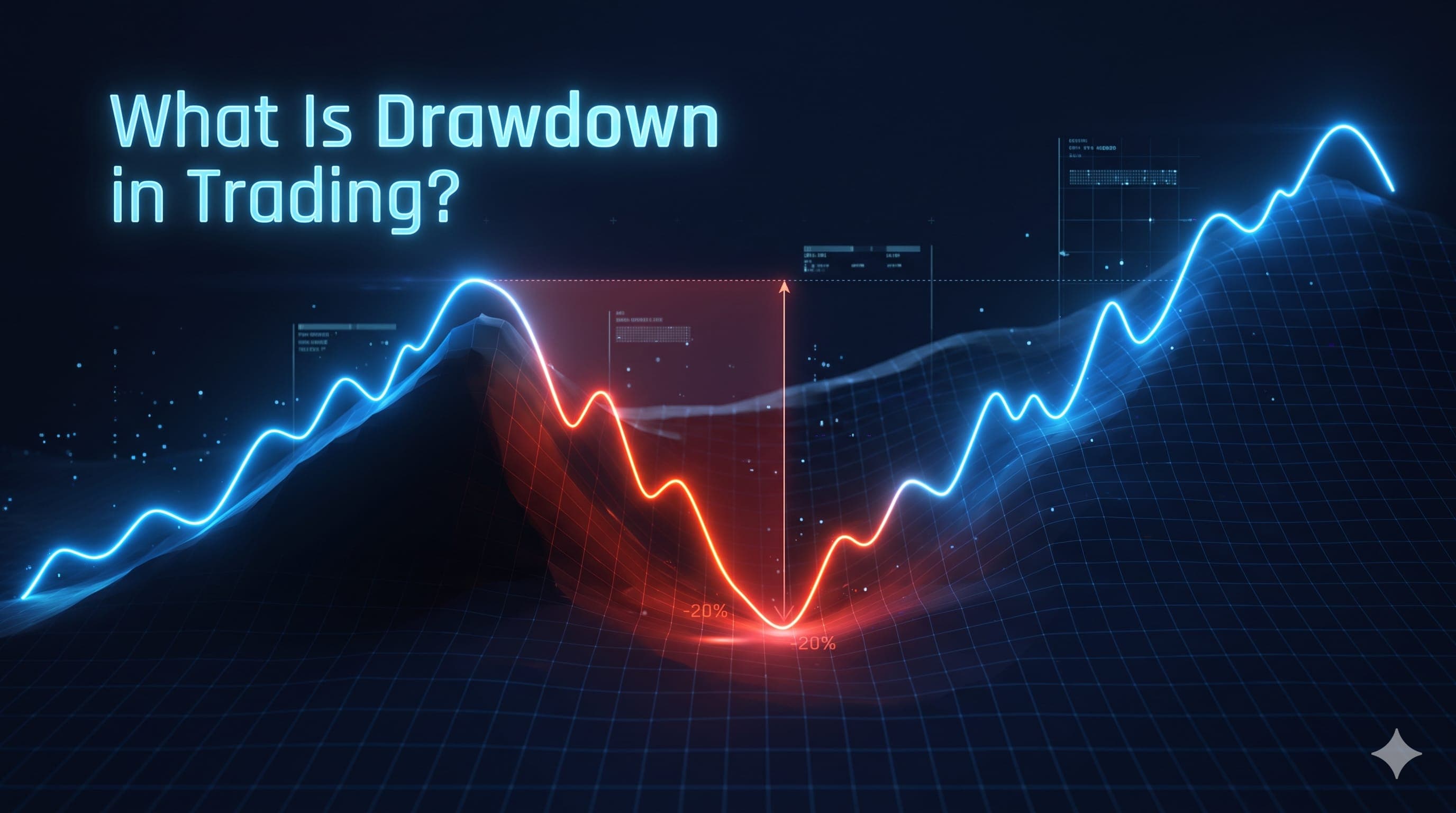
Quick answer: Drawdown in trading is how far your account falls from its highest point before it recovers, usually shown as a percentage. Daily drawdown measures the fall within one day; maximum drawdown is the largest fall across the whole history. Bigger drawdowns need disproportionately bigger gains to recover.
Key takeaways
Drawdown is measured from a peak, not from your starting balance.
A 50% drawdown needs a 100% gain just to get back to even.
Prop firms set hard daily and maximum drawdown limits, often 5% and 10%.
Risk per trade and losing streaks decide how deep drawdowns get.
Always check drawdown before trusting any track record or bot.
Every trader experiences drawdowns. What separates careful traders is that they measure them, plan for them, and keep them small enough to recover from. Here is how drawdown in trading works.
What does drawdown mean in trading?
Drawdown is the decline from a peak in account value to a later low, before a new peak is made.
Illustrative example: your account grows from $5,000 to $5,600, then falls to $5,180 before climbing again. The drawdown is $420, or $420 ÷ $5,600 = 7.5%. Notice the account is still above its starting balance, yet you are in a 7.5% drawdown.
Some measures use closed balance only. Others use equity, which includes open trades. Equity drawdown is usually larger because it captures floating losses.
What is the difference between daily and maximum drawdown?
Daily drawdown is the fall within a single trading day; maximum drawdown is the deepest fall ever recorded.
Daily drawdown tells you how damaging one bad session can be. Maximum drawdown tells you the worst stretch the method has produced so far, and it is the number that best shows how painful a method is to trade.
Prop firms use both as hard rules. Exceed either and the account usually ends. Our guide to prop firm challenge rules covers static and trailing versions in detail.
Why does recovering from drawdown get harder?
Because each percentage loss shrinks the base you need to grow back from.
Lose 10%, and you need about 11.1% to recover.
Lose 20%, and you need 25%.
Lose 30%, and you need about 42.9%.
Lose 50%, and you need 100%.
This asymmetry is why experienced traders focus on defence first. Avoiding a deep drawdown is far easier than climbing out of one.
What causes large drawdowns?
Mostly oversized risk per trade, losing streaks, and abandoning the plan after losses.
Risk per trade too high. At 5% per trade, eight straight losses cost about a third of the account. At 1% they cost under 8%.
Losing streaks. Even good methods hit streaks of five, eight or more losses. Plan for them before they happen.
Revenge trading. Raising size to win back losses turns an ordinary drawdown into a deep one.
Correlated trades. Buying EURUSD, GBPUSD and selling USDCHF at once is close to one big bet against the dollar.
Gaps and slippage. News and weekend opens can push losses beyond your stops.
Risky systems. Martingale and grid strategies can hide drawdown for months, then release it all at once.
How can you keep drawdown under control?
Fix risk per trade, set daily and overall loss limits for yourself, and reduce size during losing streaks.
Risk a small, fixed percentage. Many educators suggest 0.5% to 1% per trade. Size each trade with the position size calculator.
Set a personal daily stop. Stop trading for the day after a set loss, such as 2% or three losing trades.
Set a maximum drawdown review point. If the account falls, say, 10% from its peak, pause and review before trading on.
Cut size during streaks. Halving risk after a run of losses slows the damage while you check what is going wrong.
Track it. The FXfolder trading journal shows your equity curve, drawdown and losing streaks for members, so you see the problem early.
Why should you check drawdown before following anyone?
Because a strong profit figure means little if reaching it required a drawdown you could not survive.
When you assess a trader, a trade idea source or a bot, ask for the full history, including losing weeks. A record without drawdowns is either very short or has been edited. Our post on verified forex track records explains what an honest record looks like.
Watch how traders handle drawdowns in public, losing trades included, on FXfolder Challenges.
Frequently asked questions
What is a good maximum drawdown in forex?
There is no single number, but many traders try to keep it within limits they could recover from comfortably, often in single digits to low teens. Prop firms commonly cap it around 10%. Lower is easier to recover from.
Is drawdown the same as loss?
Not exactly. A loss is a single trade's result. Drawdown is the overall fall from a peak, which can include several losses and can happen even while the account is above its starting balance.
How do I calculate drawdown?
Subtract the lowest value after a peak from the peak, then divide by the peak. From $10,000 down to $9,200 is $800 ÷ $10,000 = 8%.
Does a stop loss prevent drawdown?
Stops limit each trade's loss but cannot stop a series of losses. Fast markets can also fill stops beyond their level. Position sizing and daily limits are needed alongside them.
Should I stop trading during a drawdown?
Not automatically, but it is wise to reduce size and review your journal. If the drawdown exceeds what your method has produced before, pause until you understand why.
Study how vetted traders frame stops and manage risk on the free FXfolder Telegram channel, or try the full community free for 7 days on the plans page.
Risk disclaimer: Forex trading involves substantial risk of loss and is not suitable for every investor. All content on FXfolder is for educational purposes only and does not constitute financial, investment, or trading advice. Trade ideas shared in the FXfolder community are posted by independent traders. Past performance is not indicative of future results. Always consider your own risk tolerance before trading.
Educational content only. Not investment advice.