What Is Leverage in Forex? A Clear Guide to Risk and Margin
Trader
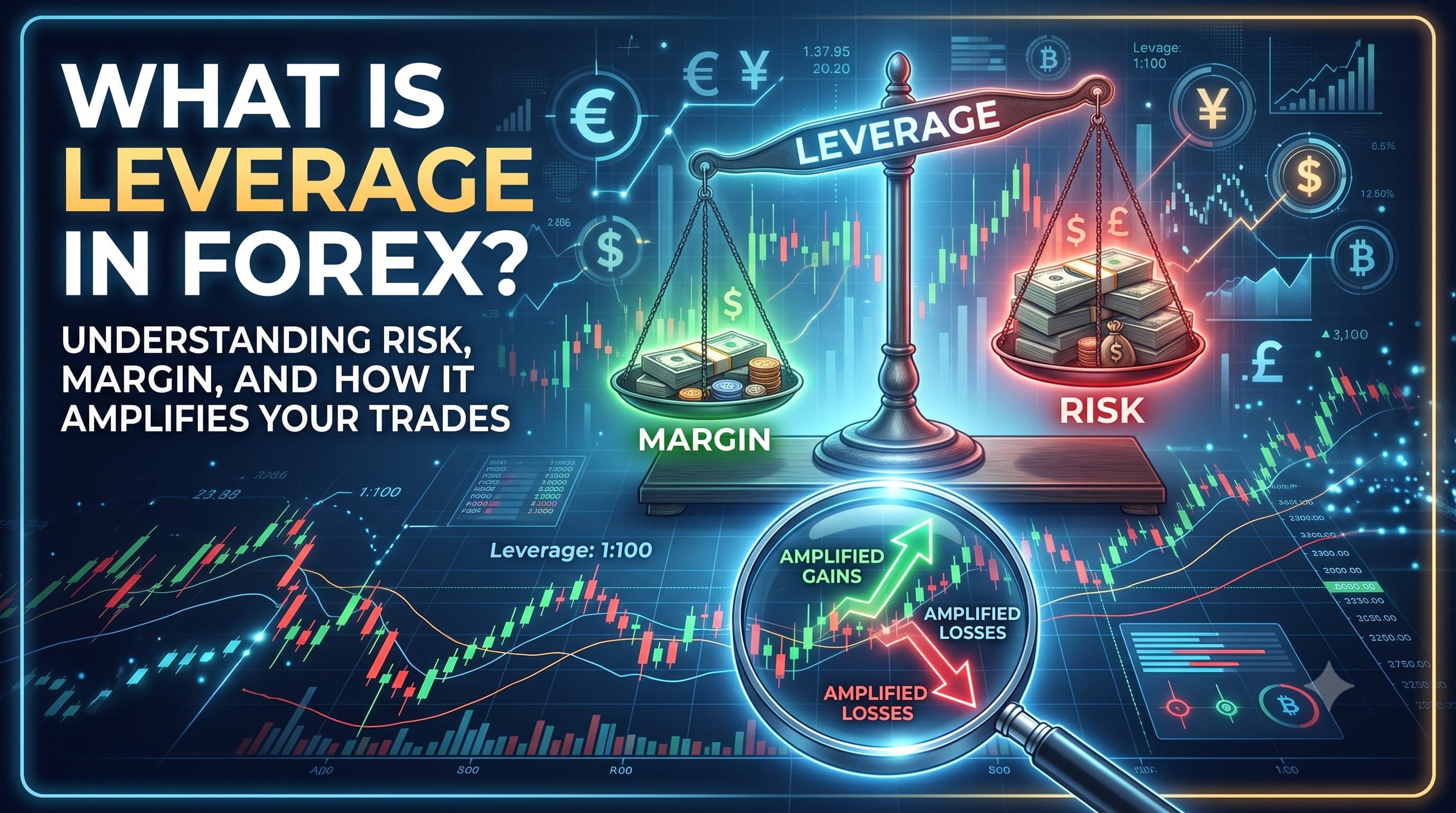
Quick answer: What is leverage in forex?
Leverage in forex lets you control a large position with a small amount of your own money, borrowing the rest from your broker. Expressed as a ratio like 1:30, it magnifies both gains and losses. Leverage is a tool, not a benefit used carelessly, it’s one of the fastest ways to lose an account.
Key takeaways
Leverage multiplies your market exposure using borrowed funds.
It magnifies losses exactly as much as gains.
Margin is the deposit your broker requires to open a leveraged trade.
Lower, carefully managed leverage is safer for most traders.
How does leverage work in forex?
Leverage lets a small deposit control a much bigger position. At 1:30 leverage, $100 of your money can control a $3,000 position. If the market moves in your favour, your gains are based on the full $3,000 but so are your losses if it moves against you.
That’s the double edge: leverage doesn’t just amplify profit potential, it amplifies risk by exactly the same amount. Many traders focus on the upside and ignore the downside a costly mistake.
What is margin, and how does it relate to leverage?
Margin is the amount of your own money the broker sets aside to open a leveraged position. It’s essentially a good-faith deposit. Leverage and margin are two sides of the same coin: higher leverage means a smaller margin requirement per trade, and vice versa.
If your losses eat into that margin too far, you can face a margin call where the broker asks for more funds or closes your position automatically. Understanding this before you trade prevents nasty surprises.
Why is leverage risky?
Because it turns small market moves into large account moves. With high leverage, a tiny price move against you can cause an outsized loss relative to your deposit. This is a major reason most retail traders lose money regulatory disclosures consistently show a large majority of accounts end up unprofitable, and over-leverage is a common culprit.
Leverage isn’t “free money.” It’s borrowed exposure that raises the stakes on every single trade.
How much leverage should you use?
For most traders, less is safer. Just because a broker offers high leverage doesn’t mean you should use it all. The smarter approach is to ignore the maximum and instead size each position from your risk risking only a small percentage of your account per trade, regardless of the leverage available.
In practice, leverage should be invisible in your decisions: you decide your risk first, and leverage simply makes that position possible it never sets how much you risk.
How to use leverage responsibly
Size from risk, not from leverage — decide your risk per trade first.
Always use a stop-loss — cap the downside that leverage magnifies.
Keep positions small — especially while you’re still learning.
Understand margin calls — know when your broker will close positions.
Never chase losses with bigger leverage — that’s how accounts end.
Leverage misused is behind many of the classic account blowing errors.
How FXfolder supports responsible trading
FXfolder is an educational community platform, not a signal seller, and it emphasises the risk-first mindset leverage demands:
Transparent trade history that shows real, risk-controlled ideas wins and losses.
Educational analysis that keeps risk front and centre.
A free Telegram community to learn responsible habits alongside others.
Frequently asked questions
What does 1:30 leverage mean in forex?
It means you can control a position 30 times larger than your deposit $100 controls $3,000. Gains and losses are calculated on the full position size, so both are magnified.
Is high leverage good or bad?
High leverage is neither inherently good nor bad it’s risky. It magnifies losses as much as gains, so for most traders, especially beginners, lower leverage and careful position sizing are safer.
What is a margin call?
A margin call happens when your losses reduce your account below the required margin. The broker may ask for more funds or automatically close positions to limit further loss.
How do I avoid losing money with leverage?
Size positions from your risk (not the maximum leverage), always use a stop-loss, keep positions small, and never increase leverage to chase losses. Risk control matters far more than the leverage on offer.
The bottom line
Leverage in forex lets you control a large position with a small deposit magnifying both gains and losses. It’s a tool that raises the stakes on every trade, not free money. Decide your risk first, always use a stop-loss, keep leverage modest, and it becomes a manageable part of your trading rather than the reason it ends.
Learn responsible trading with a community: Join FXfolder’s free Telegram channel for transparent, risk aware trade ideas.
Risk disclaimer: Forex trading involves substantial risk of loss and is not suitable for every investor. Leverage can work against you and can lead to losses exceeding your deposit with some products. All content on FXfolder is for educational purposes only and does not constitute financial, investment, or trading advice. Past performance is not indicative of future results. Always do your own research and consider your risk tolerance before trading.
Educational content only. Not investment advice.