Asian Session Forex: Range Strategy and Times in IST
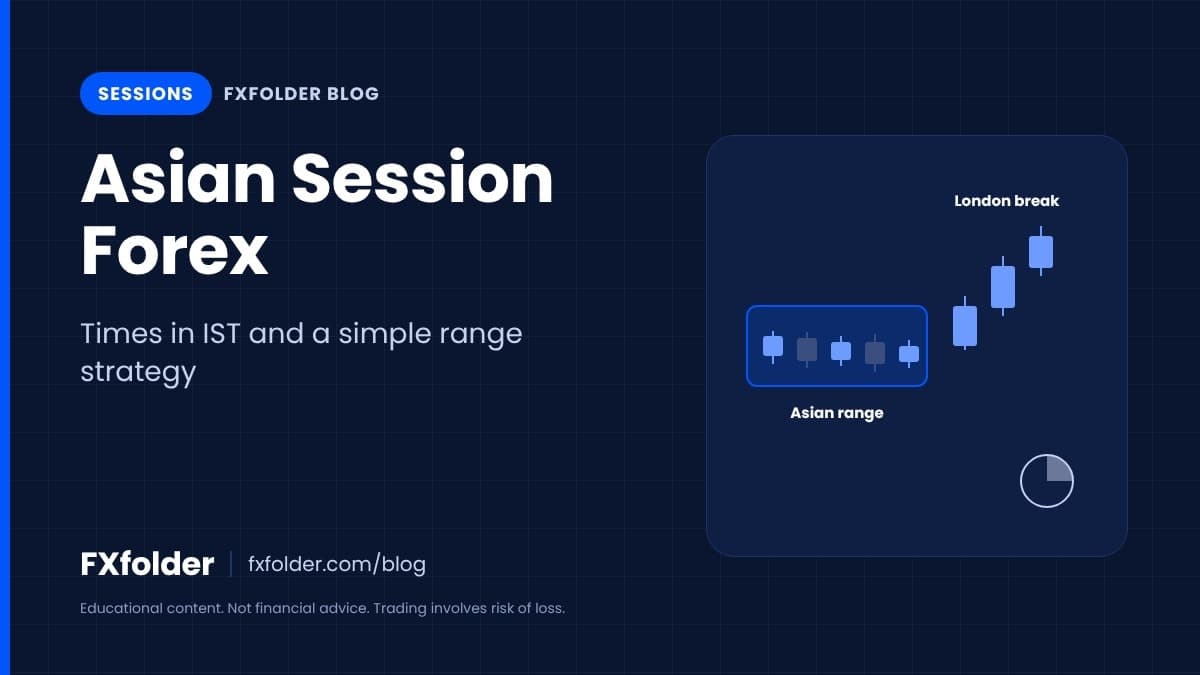
Quick answer: The Asian session forex window, led by Tokyo, runs from roughly 5:30 AM to 2:30 PM IST. It is usually quieter than London or New York, so price often forms a tight range. Traders either trade inside that range with small targets or, more commonly, mark its high and low and trade the break or sweep when London opens.
Key takeaways
The Asian session is the calmest of the three main sessions for most pairs.
JPY, AUD and NZD pairs are usually the most active then.
The Asian high and low are key reference levels for London traders.
Range trading in Asia suits small targets; breakout trading suits the London open.
Spreads can be wider in thin early hours, so check costs.
For traders in India, the Asian session runs through the morning, before work for many. It is often ignored, but the range it leaves behind shapes the rest of the day. Here is how to use it.
When is the Asian session in IST?
Tokyo runs about 5:30 AM to 2:30 PM IST, with Sydney opening earlier, around 2:30–3:30 AM IST.
Japan does not use daylight saving, so Tokyo's IST times stay steady all year. Many traders define the "Asian range" more narrowly, for example 00:00–06:00 GMT, which is 5:30–11:30 AM IST. Choose one definition and stick to it. See forex session times in IST.
Why is the Asian session quieter?
Because European and US institutions, which account for much of the global forex volume, are mostly not trading yet.
Liquidity is lower, so moves are often smaller and slower. Exceptions come with Asian data releases, Bank of Japan decisions and major weekend news at the Monday open.
Which pairs are best in the Asian session?
Pairs involving the Japanese yen, Australian dollar and New Zealand dollar.
USDJPY, AUDUSD, NZDUSD, AUDJPY and EURJPY tend to move more than EURUSD or GBPUSD at this time. Gold can be choppy in early Asian hours. See forex currency pairs explained.
Strategy 1: Trading inside the Asian range
Buy near the range low and sell near the range high, with small targets and stops just outside the range.
Works best on quiet days with clear, repeated touches.
Targets are small, so costs matter. See forex spreads.
Stop all range trades before the London open, when breakouts are common.
Strategy 2: Trading the Asian range at the London open
Mark the Asian high and low, then trade a confirmed break, or a sweep and reversal, in the London session.
At the end of your Asian window, mark the high and low.
Breakout version: enter on a candle close beyond the range in London, stop on the other side or at the midpoint. See London breakout strategy.
Sweep version: if price pokes beyond the range and snaps back inside, trade back towards the opposite side. See ICT kill zones.
Skip unusually wide ranges, where the stop would be too large, and very narrow ones, which fake out often. The ATR indicator helps judge "normal".
Size from the stop with the position size calculator.
What are the limits?
Thin liquidity, early-morning spread spikes and false breaks.
Asian ranges can break on news at any hour, and London often fakes one side before choosing the other. Test the exact rules on demo and track them in your journal.
See session-based setups from community traders on the free FXfolder Telegram channel.
Frequently asked questions
What time is the Asian session in India?
Tokyo runs about 5:30 AM to 2:30 PM IST, with no daylight saving shift. Sydney opens earlier, around 2:30–3:30 AM IST.
Is the Asian session good for trading?
It suits range trading on JPY and AUD pairs, but most major moves come later in London and New York.
What is the Asian range?
The high and low formed during a chosen Asian window, used as reference levels for the London session.
Which pairs move most in the Asian session?
USDJPY, AUDUSD, NZDUSD and yen crosses usually move more than EUR or GBP pairs.
Should I trade gold in the Asian session?
Gold can be choppy early in the Asian session. Many traders wait for London.
Learn session strategies from tracked trade ideas. Try FXfolder free for 7 days on the plans page.
Risk disclaimer: Forex trading involves substantial risk of loss and is not suitable for every investor. Strategies described are educational, not recommendations. All content on FXfolder is for educational purposes only and does not constitute financial, investment, or trading advice. Past performance is not indicative of future results.
Educational content only. Not investment advice.