How to Calculate Position Size in Forex (Step by Step)
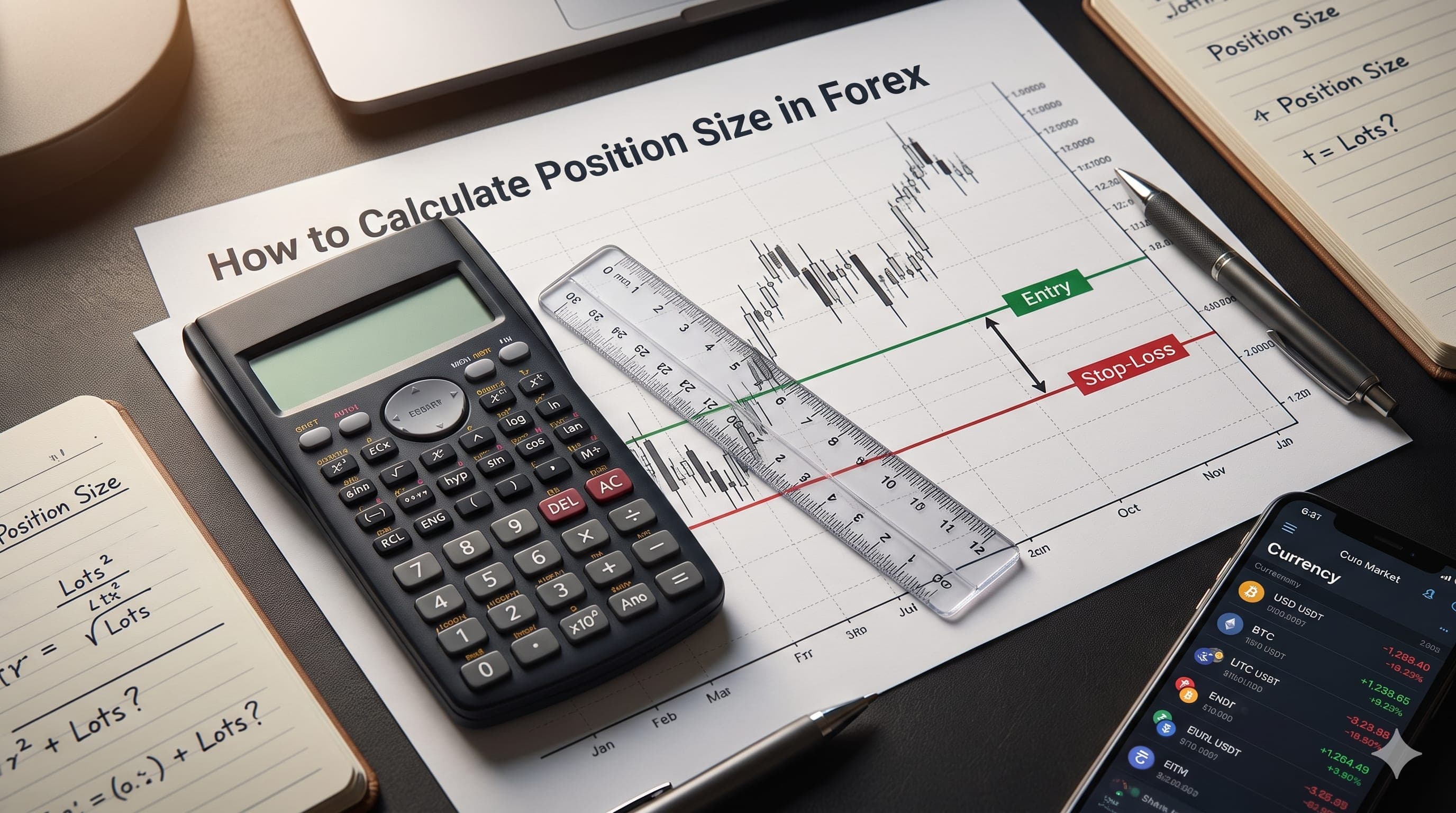
Quick answer: Forex position size = money you are willing to risk ÷ (stop loss distance × value per pip or point per lot). Risk 1% of a $1,000 account ($10) with a 25-pip stop on EURUSD, where one standard lot is worth about $10 per pip, and the position size is 0.04 lots.
Key takeaways
Decide risk in money first, then let the stop distance decide the lot size.
The stop goes where the trade idea is proven wrong, not where it fits your lot size.
Pip value changes by pair, account currency and contract size, so always check.
Gold is sized in dollars of price movement, not pips, and contract sizes vary by broker.
A calculator removes the arithmetic, but you still need to understand the inputs.
Most new traders choose a lot size by feel. That is why two trades with the same "0.10 lots" can risk wildly different amounts. Calculating forex position size properly makes every trade risk what you intended, no more.
What is position size in forex?
Position size is how many lots you trade, and it decides how much money each pip or point of movement is worth.
A standard lot is 100,000 units of the base currency, a mini lot 10,000 and a micro lot 1,000. Our guide to forex lot sizes covers these in detail. This post focuses on choosing the right number of lots for each trade.
What do you need before calculating position size?
Four inputs: account balance, risk percentage, stop loss distance and pip value.
Account balance in your account currency.
Risk percentage per trade, often 0.5% to 1% for beginners.
Stop loss distance in pips (or price points for gold), from your entry to your stop.
Pip value per standard lot for that pair in your account currency.
If a trade idea gives you an entry and stop loss, you already have the distance. See how to read a forex trade setup if you need a refresher.
How do you calculate position size step by step?
Work out risk in money, multiply stop distance by pip value, then divide the first by the second.
Risk amount = balance × risk %.
Risk per standard lot = stop distance in pips × pip value per lot.
Position size in lots = risk amount ÷ risk per standard lot.
Round down to your broker's smallest step, usually 0.01 lots.
Worked example 1: EURUSD on a USD account
Illustrative numbers. Balance $1,000, risk 1%, stop 25 pips. On EURUSD with a USD account, one standard lot is worth about $10 per pip.
Risk amount: $1,000 × 1% = $10
Risk per standard lot: 25 × $10 = $250
Position size: $10 ÷ $250 = 0.04 lots
If the stop were 50 pips, the size would halve to 0.02 lots. Same risk, wider stop, smaller position. That is the whole idea.
Worked example 2: Gold (XAUUSD)
Gold is usually sized in dollars of price movement, and many brokers define one lot as 100 ounces. On that definition, a $1 move in gold is worth $100 per standard lot. Check your broker's contract specification, because some use different sizes.
Illustrative numbers. Balance $1,000, risk 1%, stop $5 away from entry.
Risk amount: $10
Risk per standard lot: $5 × $100 = $500
Position size: $10 ÷ $500 = 0.02 lots
Gold stops are often wide, so small accounts can hit the 0.01 minimum quickly. If 0.01 lots still risks more than you planned, the honest answer is to skip the trade. Our XAUUSD trade ideas guide explains why gold moves so much.
What changes when your account is not in USD?
Pip values must be converted into your account currency, and pairs where USD is not the quote currency have different pip values.
For USDJPY, one pip is 0.01, so its value in dollars depends on the current rate. For crosses like EURGBP, pip value is in pounds and must be converted. If you hold an account in another currency, convert the risk amount and pip value into the same currency before dividing.
The simplest fix is a tool that does the conversion for you, like the free FXfolder position size calculator.
What are common position sizing mistakes?
Moving the stop to fit a lot size, ignoring costs, and stacking correlated trades.
Stop placed to suit the lot. The stop belongs where the setup is invalidated. Adjust size, never logic.
Ignoring spread and commission. On tight stops they can add a meaningful share to your real risk.
Several trades in the same direction on correlated pairs. Three 1% trades against the dollar are closer to one 3% trade.
Rounding up. Always round down so you never risk more than planned.
Using a fixed lot every time. Fixed lots with changing stops means changing risk.
Practise sizing on real setups. Every trade idea on the free FXfolder Telegram channel includes an entry and stop loss you can plug straight into the calculator.
Frequently asked questions
What is the formula for forex position size?
Lots = (balance × risk %) ÷ (stop distance in pips × pip value per standard lot). Round down to your broker's minimum step.
How much should I risk per trade?
Many educators suggest 0.5% to 1% for beginners so a losing streak does not cause a deep drawdown. The right figure depends on your strategy and tolerance for loss.
Is pip value always $10 per standard lot?
Only for pairs quoted in USD, like EURUSD or GBPUSD, on a USD account. For other pairs and account currencies, pip value changes with exchange rates.
How do I calculate lot size for gold?
Multiply the stop distance in dollars by the value of a $1 move per lot (often $100 for a 100-ounce lot), then divide your risk amount by that number. Confirm your broker's contract size first.
What if the calculated size is below 0.01 lots?
Then the trade risks more than your plan allows at the smallest size. Skip it, or wait for a setup with a tighter, still-valid stop.
Size it, log it, review it. Start a free journal at fxfolder.com/signup, or try the full community and analytics free for 7 days on the plans page.
Risk disclaimer: Forex trading involves substantial risk of loss and is not suitable for every investor. All content on FXfolder is for educational purposes only and does not constitute financial, investment, or trading advice. Trade ideas shared in the FXfolder community are posted by independent traders. Past performance is not indicative of future results. Always consider your own risk tolerance before trading.
Educational content only. Not investment advice.