Revenge Trading: Why It Happens and How to Stop It
Quick answer: Revenge trading is taking impulsive trades after a loss to "win the money back", often with bigger size and weaker setups. It usually turns a normal losing day into a serious drawdown. The fix is to decide in advance when you stop: a daily loss cap, a maximum number of losing trades, and a forced break after you hit either.
Key takeaways
Revenge trading is an emotional reaction, not a strategy.
The classic signs are bigger size, faster entries and skipped rules after a loss.
Rules set before the session beat willpower during it.
A daily loss cap and a two-loss stop are simple, effective limits.
Your journal shows whether it is happening, even if you deny it.
Almost every trader has done it: a stop gets hit, frustration builds, and the next trade comes too fast and too big. Revenge trading is listed in our guide to common forex trading mistakes. Here is a closer look at why it happens and how to stop it.
What is revenge trading?
It is trading driven by the urge to recover a loss immediately, rather than by your plan.
The trade might be in any direction and on any setup. What defines it is the motive: to undo the last result. That motive pushes traders to ignore their rules, increase size and accept setups they would normally skip.
Why do traders revenge trade?
Because losses hurt more than equal gains feel good, and the mind wants to end the discomfort quickly.
Behavioural finance calls this loss aversion. Add the belief that the market "owes" you, the speed of modern platforms and a phone in your pocket, and impulsive trades become easy. Fatigue and late-night sessions make it worse, which matters for traders in India trading the US session in the evening.
What are the warning signs?
Changes in size, speed and standards right after a loss.
Increasing lot size to recover faster.
Entering within minutes of a stop being hit.
Trading a pair or setup you do not normally trade.
Moving or removing stops "to give it room".
Thinking about the money lost rather than the setup.
Why is revenge trading so damaging?
Because it combines bigger risk with worse setups, which is the fastest route to deep drawdown.
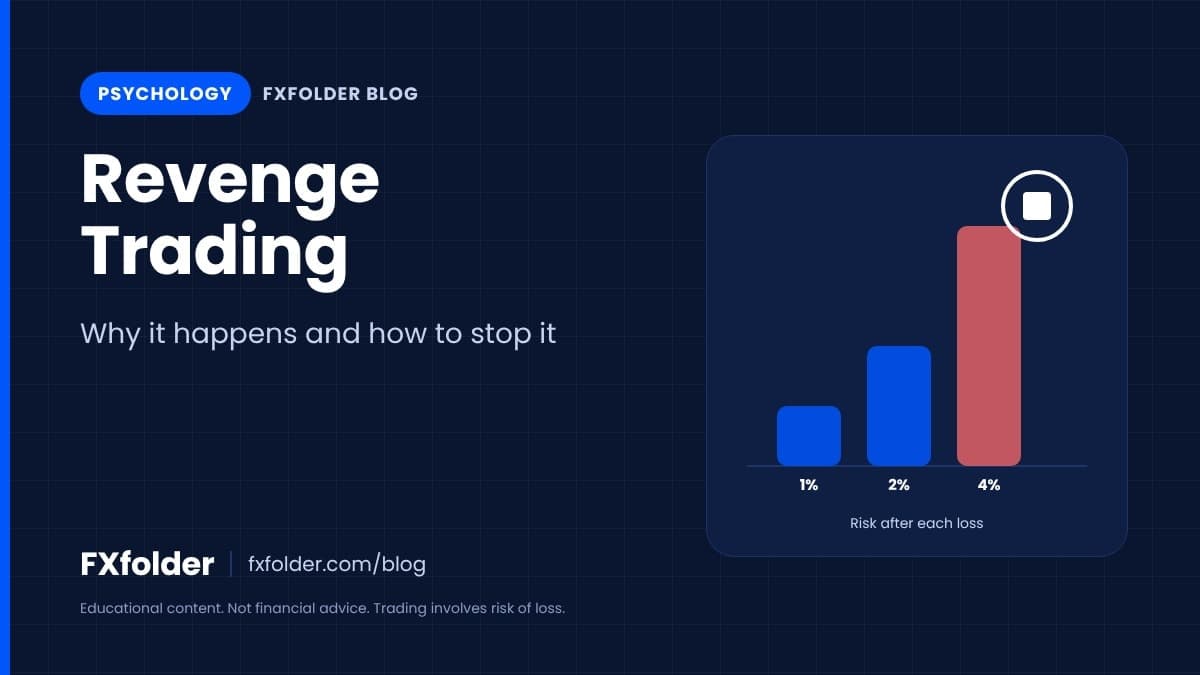
Illustrative example: a trader risks 1% and loses. Doubling to 2% to recover, then losing again, then 4%, means three losses cost 7% instead of 3%. Recovering from deeper drawdowns takes disproportionately larger gains. See what is drawdown in trading.
How do you stop revenge trading?
Set limits before you trade, make them automatic where possible, and use a reset routine.
Fixed risk per trade. The same percentage every time, sized with the position size calculator.
Daily loss cap. For example 2% of the account, after which you stop for the day.
Two-loss rule. After two losses in a row, stop and review.
Cooling-off timer. Wait at least 30 minutes after any loss before the next trade.
Write the setup first. No trade unless you can write its entry, stop, target and reason in one line.
Automate where you can. The FXfolder trading journal includes risk guardrails, such as a daily loss limit and a trade-count ceiling. For prop accounts, PropPilot (beta) stops new trades at a level you choose.
How can a journal help?
It shows patterns your memory hides, such as how trades taken right after a loss perform.
Tag each trade that follows a loss within 30 minutes. After a month, compare their results with your other trades. Many traders find those trades have clearly worse expectancy. See expectancy explained.
See how disciplined traders handle losing weeks in public, losses included, on FXfolder Challenges.
Frequently asked questions
What is revenge trading in forex?
Taking impulsive trades after a loss to win the money back quickly, often with larger size and weaker setups.
How do I stop revenge trading?
Set a daily loss cap and a maximum number of consecutive losses before you start, then stop trading for the day when you hit either.
Is revenge trading the same as overtrading?
They overlap. Overtrading is taking too many trades for any reason; revenge trading is a specific type driven by the urge to recover a loss.
Why do I keep trading after a loss?
Losses trigger strong emotions and a wish to end the discomfort quickly. Pre-set rules remove the decision from the heat of the moment.
Can a trading bot stop revenge trading?
Automated limits can block new trades after a set loss, which helps. They do not fix the underlying habit, so pair them with a review routine.
Build discipline with tracked trade ideas and a free journal. Try FXfolder free for 7 days on the plans page.
Risk disclaimer: Forex trading involves substantial risk of loss and is not suitable for every investor. All examples are illustrative. All content on FXfolder is for educational purposes only and does not constitute financial, investment, or trading advice. Past performance is not indicative of future results.
Educational content only. Not investment advice.