Forex vs Stock Market: Key Differences Explained
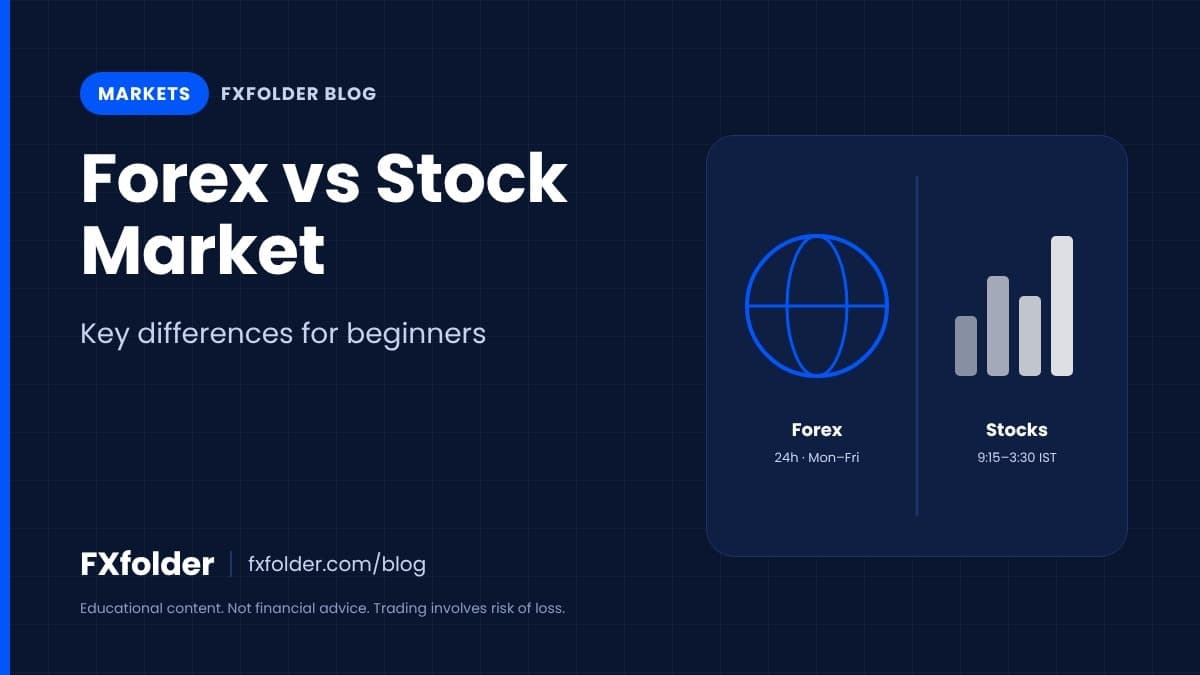
Quick answer: The forex market trades currency pairs around the clock on weekdays and is driven mainly by interest rates and economic data. The stock market trades shares in companies during exchange hours and is driven by company results and sentiment. Forex usually offers higher leverage, which raises risk. Stocks also suit long-term investing; forex is mostly short-term trading.
Key takeaways
Forex runs nearly 24 hours on weekdays; stock exchanges have fixed hours.
Forex focuses on a handful of major pairs; stocks offer thousands of companies.
Forex prices move on macro data; stocks move on company news too.
Leverage is typically higher in forex, which magnifies losses.
Rules on who can trade what differ by country.
Many traders in India start with stocks and later get curious about forex, or the other way round. The two markets work quite differently. Here is an honest comparison of forex vs the stock market.
What do you actually trade in each market?
In forex you trade one currency against another; in stocks you buy and sell shares of companies.
Buying EURUSD means buying euros and selling dollars at the same time. Buying a stock means owning a small part of a company, which can also pay dividends. See forex currency pairs explained.
How do trading hours compare?
Global forex runs about 24 hours from Monday to Friday; stock exchanges open only during set hours.
In India, the NSE and BSE equity segments trade from 9:15 AM to 3:30 PM IST on weekdays. Global forex sessions run through the day and night, with the busiest window in the evening IST. See forex trading hours in India. That evening activity is one reason forex appeals to people with daytime jobs.
What moves prices in each market?
Forex moves mainly on interest rates, inflation, jobs data and central bank decisions; stocks move on earnings and company news as well as the economy.
A forex trader watches FOMC, CPI and NFP. A stock trader adds quarterly results, management changes and sector trends.
How do leverage and risk compare?
Forex brokers usually offer much higher leverage than stock trading, which makes both gains and losses larger relative to your deposit.
High leverage is the main reason many new forex traders lose money quickly. Size positions from your stop loss, not from the leverage available. See what is leverage in forex.
How do costs compare?
Forex costs are mainly spread, commission and overnight swap; stock costs include brokerage, exchange fees and taxes, which vary by country.
Frequent short-term trading in either market adds up. See forex spreads and swap in forex.
Which is better for long-term investing?
Stocks, generally. Currencies do not grow in value like companies can, so forex is mostly a trading market rather than an investing market.
Some traders do hold forex positions for weeks or months, but swap costs and the lack of dividends or company growth make it a different proposition.
Which suits beginners?
It depends on your goals, schedule and risk tolerance.
Stocks may suit you if you want to invest for years, follow companies you know and avoid high leverage.
Forex may suit you if you want to trade short-term around a busy daytime job, prefer macro analysis, and will keep leverage low.
Whichever you choose, start on a demo account. See how to use a forex demo account.
Rules on which forex products residents can trade differ by country. Readers in India should check what is permitted before opening any account.
Curious about forex? See how vetted traders frame trade ideas on the free FXfolder Telegram channel.
Frequently asked questions
Is forex riskier than the stock market?
Forex is often riskier for beginners because of high leverage and fast moves. Both markets can lose you money.
Which is more profitable, forex or stocks?
Neither is reliably more profitable. Results depend on skill, risk management and costs.
Can I trade forex and stocks together?
Yes, many traders do. Keep separate risk limits and track them in separate journal accounts.
What are stock market hours in India?
NSE and BSE equity segments trade from 9:15 AM to 3:30 PM IST, Monday to Friday, excluding holidays.
Is forex better for part-time traders in India?
Global forex sessions are active in the evening IST, which can suit people with daytime jobs. Check what products you are permitted to trade where you live.
Explore forex with tracked trade ideas and a free journal. Try FXfolder free for 7 days on the plans page.
Risk disclaimer: Forex and stock trading involves substantial risk of loss and is not suitable for every investor. Product availability and rules differ by country. All content on FXfolder is for educational purposes only and does not constitute financial, investment, legal or trading advice. Past performance is not indicative of future results.
Educational content only. Not investment advice.